Friday, January 19, 2018

"Ballhog" is a loose definition

There’s a common adage in life that the more things change, the more they
stay the same.
Since leaving the industry after 18 years in December 2014, I have not been
to a high school basketball game as a reporter or spectator. That is not to suggest
I wouldn’t like to do so but after helping my former employer (Napa Valley Register)
cover high school football after work in the fall, I like getting my Friday night’s with
my family back. I could attend mid-week games but given my long day of physical
work coupled with a near Jon Gruden-like wakeup call, I have to value rest at some
point. That is another story for another day.  
For starters, every team has a leading scorer. It did, however, amaze me how the
term “ball hog” became loosely attached to that player — and I saw it on virtually
every team I covered throughout my career.
That player gets labeled as being selfish or not a team player.
I can give you an extreme example. I will leave names out to protect the innocent
but one team I covered had a prolific scorer who was labelled a ballhog. One of
the youngter’s teammates had a grandfather that was in not so many words, a
loudmouth schmuck, know-it-all. So the coach let him record stats in the scorebook.
He would normally ask to see my stats and how much they matched up with his.
The scoring stats were on point. It was the rebounding, steals and assist stats of
his grandson along with the field goal attempts of the aforementioned prolific scorer
not named “my grandson.”
This grandfather had an agenda not only for his grandson but against the prolific
scorer. Said grandfather routinely recorded double the amount of rebounds, steals
and assists for his grandson. The running joke became, “grandfather must give a
rebound and steal for every finger his grandson grabs the ball.” Also, “if grandson
was the first of four passes leading to a basket, it was an assist.” Mind you, I thought
nothing but great things of grandson. He was a fine young man and a diligent
student-athlete.
The one stat I will never forget was the one he recorded for the prolific scorer, who
incidentally had his father as the head coach. That added yet another layer to said
grandfather having a redass for that family. In a 32 minute high school basketball
game, he recorded 76 field goal attempts for the prolific scorer. Process that for a
moment. There are NBA teams don’t take 76 shots in a 48 minute game. So I guess
that pass into the post counted as a shot?
Is the “ballhog” label warranted at times? Perhaps so, but like anything, there can be
two sides to every story. First, there’s the person and/or parent giving that player the
label out of a jealousy complex.
I had the privilege of covering former Vallejo High star DeMarcus Nelson, who
transferred to Sheldon (sacramento) before starring at Duke University. Though not
on Nelson’s level, in my 10 years on the Upvalley beat in Northern California, I had
the chance to witness prolific scorers like John Adams, Cole Ballentine, Alec Fetzer
on the boys side for St. Helena High. For the girls, Maddy Densberger and Holle
DePina were high-point scorers. For Calistoga, I had the pleasure of witnessing
Donnie McMahon for the boys and Julia Hoff for the girls.
Nelson averaged about 25 points per game but also normed double figures in
rebounds, as well as about eight assists and four steals per game. Yet, some
numbskulls who followed the Apaches (parents or otherwise) in that time labeled
Nelson as selfish.
When a guard averages double-figure rebounds and has assists totals among the
top 15 in the section, where does the “selfish” part enter the equation?
For starters, every basketball player alive — star player or otherwise — needs better
shot selection sometimes. It doesn't matter if it’s grade school, high school, college,
NBA or the 50-and-over city league.
On the other hand, sometimes that player’s teammates are just as guilty as the player
himself or herself for being a ball hog.
Why, you ask? We laud players at any sport for being aggressive.
If anything, we often preach that it’s better to have a player be overaggressive than
one that’s too timid.
In addition, if you are a teammate of this star player that is labeled as a selfish ball
hog, you can’t have it both ways.
Meaning, you can’t ask that player to bail you out when the going gets tough but
then pass up an open shot when you’ve got it.
If you pass up an open shot that you are fully capable of making and that teammate
of yours jacks up an off-balance 15-foot fadeaway jumper with two defenders draped
all over him or her, then you are to blame.
The other side of the argument is that the star player must believe in his or her
supporting cast.
I’m all for teamwork, but the supporting cast of that star player must give reason
for the lead horse to believe in them. And yes, that’s taking an open shot you are
fully capable of making.
If you miss, so what.

Tuesday, January 16, 2018

Wrestling faces uphill climb in growing their brand

Sometimes one story leads to other thoughts.


There was a noticeably absent participant at Monday’s King of the Valley wrestling
tournament at Justin-Siena High’s Dan Clark Gym.


In a blog entry last month, yours truly chronicled how St. Helena High, which was a
once storied wrestling program, died a slow death that has since resulted in the sport
going on hiatus until further notice:


The King of the Valley tournament was established in 2007 that started with St. Helena,
Justin, Napa and Vintage with American Canyon being added in 2011. St. Helena won
the 2007 and 2008 editions. Napa then followed by winning the next seven from
2009-2015. American Canyon won the 2016 event. On Monday, Vintage captured its
second King of the Valley tournament in as many seasons.


Seeing St. Helena’s decline raised another point with me. While much of the narrative
has focused on a decline in football participation, wrestling participation has also
decreased nationwide. According to statisa.com, wrestling participation has seen a
decrease of 10.2 nationwide since 2009. In that same span, high school football
participation has fallen by 4.6 percent.


Reasons for the decline of football participation include but are not necessarily limited to
various retired NFL players have been diagnosed with head trauma that includes but early
onset of dementia as a result of concussions suffered in their playing days. Such outcomes
have made parents exceedingly leery of having their kids play football.


With a decline in football participation, it stands to reason there is a correlation to a decrease
in wrestling participation because it has been common for football players to wrestle. The
reasoning is because of the overlap in technique and conditioning. However, I decided to
expand the topic on social media so I asked my various friends that either wrestled
competitively or coached the sport if they had additional thoughts. I found some compelling
answers.


In my 18 years as a sports reporter, I had a chance to cover wrestling greatness. Among
sports offered at the high school level, wrestling is perhaps the most physically demanding.
I know some will have differing opinions but that is another story. For openers, there is
physical contact and bodies being contorted every which way. The sport is also hell on
metabolism in that if one is trying to drop weight to make a certain class, it’s not unusual
to go on a starvation level diet. Conversely, if one is trying to gain weight to move up a
weight class, the youngster will be eating far more than normal.


Since wrestling is considered a nonrevenue sport, it becomes that much easier to drop if
participation numbers are down. While football participation numbers are on the decline,
that sport is the financial bellcow of most every athletic program.

Youngsters today undeniably have more technological distractions between the internet,
social media and text messaging. I know that viewpoint has Captain Obvious written all
over but such is a factor. Another narrative is that parents in general are exceedingly
over-protective of their kids. I believe there is some truth to that notion but it's hard for me
to ascertain exactly how much.


Though I love football and think some of the safety concerns are overblown, I can understand
parents not wanting their kids to play the sport even if I may not agree with their reasons. I'm
not going to push football on my 9-year old son. I'll let him make the call. Wrestling, though
physically demanding, is actually one of the safer sports given that weight classes are the
equalizer. Plus in a small area, guys aren't moving fast enough to get hurt. Don’t get anything
twisted. By no means am I suggesting injuries cannot happen in wrestling.


The increased popularity of MMA (Mixed Martial Arts) and UFC (Ultimate Fighting
Championship) is another attributable reason for decreased wrestling participation.


I could point to the lack of exposure wrestling gets but that problem has always been present.
Wrestling coaches and parents frequently feel short-changed on media coverage -- and
understandably so. In my ten years on the St. Helena beat, most involved the Saints having
better wrestling teams than basketball. Saints wrestling was the main story and dominant
photos more weeks than not but that did not seem to move the needle with the readership.
One reader told me, “I know why you are making wrestling top billing, and they should be,
but I can’t get interested in reading about wrestling.”


Though I had my reasons for making such a decision, I understood that person’s line of
thinking. Olympic sports like wrestling, track and field along with swimming continue to
fight the uphill battle of growing their brand. That battle only gets steeper because earning
potential is exponentially greater in mainstream sports.


Though I have utmost admiration for the commitment that wrestlers show, it is not a
spectator friendly sport. Having covered numerous tournaments where my coverage was
focused on local student-athletes, the down time is enormous. Tournaments are usually
held out of town where you might sit around most of the day. I’ll be brutally honest, unless
it involves my job or my kid, I would not go. Dual meets, however, can be entertaining in
their own right. Such events are centered around individual matchups but involve team
scoring. Most importantly, there is one mat where the attention is centered.

Saturday, January 13, 2018

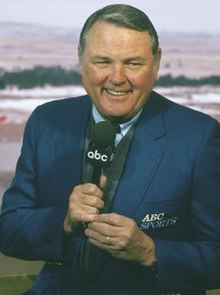
"Whoa, Nellie!" Keith Jackson was a one of a kind

Do you ever have another one of those days where you discover another part of your
childhood and for that matter adulthood gone?


That moment came on Saturday morning as I was running errands. I looked at my
Facebook news feed on my phone and one of my friends posted that iconic sportscaster
Keith Jackson died at age 89.


Jackson was a play-by-play broadcaster for a variety of sports but is best known for his
work as a college football broadcaster. When you heard his voice, you knew it was college
football Saturday. Jackson’s broadcasting work included Major League Baseball, NBA,
boxing, auto racing, PGA golf, the USFL and Olympic Games.


His voice was a mixture of intelligence, folksy and distinctive with a deep cadence.
The tone of Jackson’s voice was considered akin to Edward R. Murrow reporting on
World War II. Though I mean no disrespect to others, Jackson was the authority when
it came to college football and everyone else was batting second.


Jackson’s evolution to iconic status is one I find incredibly fascinating. Jackson grew up
on a farm in Georgia, just outside the Alabama state line. He was the lone surviving child
in a poor family and grew up listening to sports on the radio. After enlisting and serving
in the U.S. Marine Corps, he attended Washington State University under the G.I. Bill. He
became interested in broadcasting and the rest, as they say, is history.


Like many legendary broadcasters, Jackson had his go-to expressions. With Marv Albert,
you have “YES, and it counts!” With Dick Enberg, it was “OH my!” With Bill King, it was
“HOLY Toledo!” I could give endless examples but in the interest of space, I’ll focus on
Jackson because of timeliness. First there was “Whoa, Nellie!” If there was a fumble,
Jackson would inflect “Fum-BLE!” My other favorite when there was a penalty was “Hold
the phonnnnnne!” It wasn’t so much the words but the inflections.


He would commonly refer to offensive and defensive linemen as the “Big Uglies.” I
remember watching one game where the camera cut away to a full moon. Jackson in
his deep Southern drawl uttered, “That there is a possum huntin’ moon.” Jackson was
also known for describing big bodied guys as “That guy is as big as a hus (meaning
horse).” Among other things, Jackson was known for coining the phrase “The Big
House” in reference to Michigan Stadium.


There were a couple of other phrases I remember that were more isolated. I forget the
teams that were involved but that’s immaterial. One of such games involved a blowout
and in the fourth quarter, coaches on both sides pulling their starters from the game.
The camera panned to a star player and Jackson goes, “If he lights a cigar, he ain’t
comin’ back.” Another game involved a running back fighting really hard for extra
yardage and while describing the action, Jackson utters, “He’s a fightin’ and a scratchin’
and a kickin’ and a churnin’”


Jackson’s passing resonates for me on a different level. Though I have spent most of
my life in Napa, CA, I got my Bachelor’s Degree from the University of Nebraska in
Journalism. I won’t go into the current state of Nebraska football other than saying we
are like a fallen champ trying to rise from the canvas. I lived in Lincoln, NE, from
1994-1998. The Huskers won three National Championships in four years. That era was
one of greatness I will never forget. Since Jackson was the lead voice of college football,
I had the pleasure of hearing him do a number of Nebraska games.


However, even if Jackson was not broadcasting your team’s game, you would watch to
hear any phrases or stories Jackson would tell. Even as generations changed, Jackson
still had an old-fashioned but yet wide-eyed love for the sport. That quality is significant
because if any organization can bring out your cynical side, it is the NCAA. Jackson,
however, shunned controversy -- or at least he addressed such issues at no more of
a level than he needed. In short, Jackson stayed true to being a member of the media
rather than a story-breaking journalist.


Jackson was set to retire after the 1998 season but later had a change of heart. ABC
suggested that Jackson concentrate on Pac 10 games so as to limit his travel, in part
due to advancing age, so as to stay close to his Southern California home.


We were treated to seven more years of the iconic one and his final game was the
Rose Bowl, otherwise known as “The Granddaddy of Them All.” His final game was
the 2006 Rose Bowl as Texas rallied to defeat USC 41-38, one of the best games in
college football history.


Though he had not been in a broadcast booth since that night, I have no doubt that when
I watch my first college football game next season, I will be thinking of Keith Jackson.


I might have to christen the season by yelling at my TV, “Whoa, Nellie!”

The distinction between "team" and "program"

If I had a dollar for every time a coach — and yes, yours truly — used the term
“culture,” I could retire anywhere by choice tomorrow.
So on a whim, I looked up the term in an online dictionary and the closest I could
find to it pertaining to sports is, “the set of values, conventions, or social practices
associated with a particular field, activity, or societal characteristic.”
Think about that for a moment — successful sports programs are created and establish
a set of values and practices they hope to have staying power.
Throughout my 18 years of sports journalism, which was my previous career and remains
my current hobby, most successful coaches would concur that much of the emphasis is
about establishing a culture in order to have long-term, sustained success. I have always
espoused the philosophy that there is a difference between a “team” versus a “program.”
I could think of any number of examples but among the ones I covered regularly or
witnessed infrequently included but are not limited to, with sport in parenthesis, are:
Napa (football, girls basketball), Justin-Siena (baseball, football, girls basketball),
American Canyon (football), Vacaville (football, wrestling), Middletown (football),
Calistoga (soccer, softball), Rincon Valley Christian (basketball) St. Helena (wrestling,
volleyball, football, soccer), Ferndale (football), Tomales (football) Benicia (baseball)
Clear Lake (softball) and Cloverdale (basketball, softball). Some of the aforementioned
programs are still going strong while others have faded. I could include De La Salle
(Concord, CA) Cardinal Newman (Santa Rosa, CA) or Marin Catholic (Kentfield, CA)
in more than a few sports as well. We can probably think of several other schools or
sports around the entire United States but in the interest of space I’ll limit to my own
observations.
Those programs I mentioned have (or had if success is past tense) one common denominator.
The focus was never about which seniors were graduating or how much each was losing.
The preseason narrative was “I don’t give a damn who they just lost, that program will find
ways to win.” At the smaller school level like St. Helena, Middletown, Ferndale Cloverdale
or Tomales, those schools would not win regularly because their athletes were so much better
than their league foes. They won because the program had an identity and was a well-oiled
machine from top to bottom. As a result, the team was already a step ahead of its competition.
To further divide the distinction between “team” and “program,” with the former, the emphasis
is to build for a season. With the latter, it’s about success that has staying power.
Granted, some years the roster will have more talent than other seasons, and occasionally there
will be a down year. However, one down year is not going to become, say, two or three.
So what are the keys to having a good program versus a good team?
Everyone has their theories, but just to name a few, administrative and community support,
coaching, talent and continuity of a system certainly help, too, because so much of winning
is centered around making fewer mistakes.
Developing leadership has to become a factor as well. As in, leadership from players as well
as coaches.
Why is that important? Isn’t that why you have coaches?
True. Leadership comes from coaches, because they are the adults in the situation, but having
leadership from players is also vital.
Everyone has their own idea of what type of leader is better — one that leads vocally or by
example? Both are important but the former is really crucial. However, in order to balance
the scale, you need a few players that can step in to become leaders because it’s human nature
to turn someone’s message off if it is coming from the same person all the time.
Whereas, if a few players that are team leaders preach the same message that the coach
emphasizes, then the coach’s message carries that much more weight.
So how does a young man or young lady become a team leader? There is no hard and fast
answer other than the person evolves into that role over time.
It is also important that someone stays true to their personality. If a youngster is not a vocal
person in the first place, you are probably setting them up to fail if you try to make them
become a vocal leader.
It’s also important to be a leader, and sports, once again, teaches people good leadership skills.
No matter the title, everyone who participates in sports will eventually get to the leadership
spot, or, if nothing else, they will observe, admire, and hopefully learn from the leaders that
came before them.
It’s a crucial quality to be able to lead people in a positive, supportive way without losing
respect along the way.
Leadership skills benefit everyone throughout their life, because there will always be a
situation, where someone needs to take charge and lead others to victory.

Wednesday, January 10, 2018

Gruden's return adds intrigue to Bay Area football in 2018

With Jon Gruden’s return as the head coach of the Oakland Raiders, the NFL in the
San Francisco Bay Area became very compelling for the 2018 season.


It just so happens that the Raiders and San Francisco 49ers meet at Levi’s Stadium
in Santa Clara at a date to be determined. Please, spare me the Santa Clara 49ers
line, will you. There are a few teams in professional sports not playing in the city
that identifies the team. Throwing shade like that is pretty amateurish and weak.


Since the two teams are in opposite conferences, they only play each other every
four seasons. That reason is one why I will never call 49ers/Raiders a rivalry but I
would say it is a rivalry between the fans more so than on the field.


I had a chance to listen to Gruden’s press conference today while driving my route
truck for Alhambra Water. My goodness, it was captivating. Gruden’s charisma whether
as a coach, broadcaster or speaker is very E. F. Hutton like. When he talks, people
listen. For the thumbnail sketch of Gruden’s return to coaching, read this entry:


The 49ers and Raiders each went 6-10 last season but watching the seasons unfold in
real time, the two seasons could not have felt more different. San Francisco went a combined
7-25 in 2015 and 2016 under Jim Tomsula and Chip Kelly respectively after the organization
euphemistically fired Jim Harbaugh after the 2014 campaign. They called it a “mutual parting”
but that’s a euphemism for “they fired him” if you ask me.  


Very few expected the 49ers to win more than four games under first-year head coach Kyle
Shanahan, who along with general manager John Lynch received a six-year contract. San
Francisco lost its first nine games, five by three points or less. The 49ers then sent a
second-round draft pick to the New England Patriots for quarterback Jimmy Garappolo.


Upon inserting Garappolo into the starting lineup, San Francisco finished the season with
five straight wins. You would be hard-pressed to find a better in-season turnaround than
the 2017 49ers going from 0-9 to winning six of their last seven to go 6-10.


After going 12-4 in 2016, reaching the playoffs for the first time since 2002, the Raiders
entered 2017 with aspirations of being a Super Bowl contender. The hopes appeared
warranted thanks to the return of quarterback Derek Carr, a solid offensive line and skill
position players. Oakland started the season 2-0 before losing 27-10 at Washington.
The Raiders, despite their struggles, still had postseason aspirations at 6-6. Instead,
Oakland did its best Greg Louganis impersonation in that the team took a dive losing four
straight to close the season.


The Raiders dismissed head coach Jack Del Rio moments after the season-ending 30-10
loss to the Los Angeles Chargers.


I cannot readily recall two teams in the same region both recording 6-10 seasons, yet there
is so much excitement pertaining to the following campaign. The teams will be picking No. 9
and 10 in the NFL Draft, decided by a coin flip at a date to be determined.


While it is far too soon to predict win-loss records, you start by looking at each team’s division
landscape. For the Raiders, in the AFC West, Kansas City continually finds ways to cough up
a furball in the playoffs but you know they will be a tough out in the regular season. The
Chargers have an intriguing nucleus on defense led by Joey Bosa and an aging but still
effective Philip Rivers at quarterback. The Broncos are a mess and have no quarterback.


For the 49ers, in the NFC West, Arizona is circling the drain, both head coach Bruce Arians
and quarterback Carson Palmer are retiring. Seattle has one of the best quarterbacks in the
business in Russell Wilson but an aging defense. The Rams, meanwhile, have the most
solid nucleus.


The biggest question for San Francisco is “how will the team handle having expectations?”
The biggest question for the Raiders is “are they the 12-4 team from 2016 or the 6-10 team
from 2017?” I would split the difference since the 12-4 mark of 2016 involved Fool's Gold.
The team was 8-1 in games decided by seven points or less. However, I don't see next season
going off the rails like 2017 either.

I could see the 49ers going 10-6 but with a coach/GM tandem of Shanahan and Lynch, I
don’t see this team flaming out. I see 8-8 if they disappoint.


I think the Raiders have a higher ceiling than the 49ers but also a lower floor.

Count me among those hoping the 49er-Raider game is a primetime contest.